
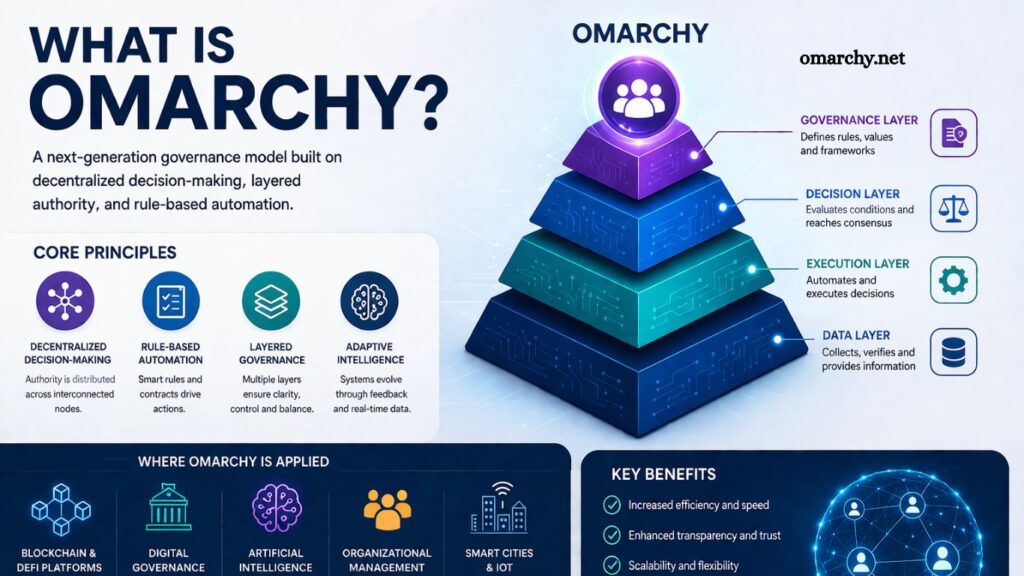
Omarchy represents an emerging concept that blends structured digital governance, decentralized systems, and hierarchical automation into a unified framework. The term is increasingly used in discussions of organizational models, blockchain-inspired governance, and advanced system architectures in which authority, rules, and decision-making follow layered intelligence rather than traditional centralized control.
Understanding Omarchy requires exploring how modern systems evolve beyond conventional hierarchies. Traditional models rely on fixed leadership structures in which decisions flow from top to bottom. Omarchy introduces a more dynamic structure in which authority is distributed across interconnected layers, often supported by algorithms, smart contracts, or rule-based automation.
This article explains Omarchy in detail, including its core principles, potential applications, and growing relevance across technology, governance, and digital ecosystems.
Origin and Concept of Omarchy
Omarchy is derived from the combination of “omni,” meaning all-encompassing, and “archy,” meaning governance or rule. Together, the term suggests a system of all-encompassing governance where control does not rely on a single authority but instead emerges through interconnected layers of structured intelligence.
Modern interpretations associate Omarchy with decentralized decision-making systems. These systems rely on predefined rules, automated execution, and distributed participation. Unlike anarchic models that eliminate structure, Omarchy maintains order through layered protocols and intelligent coordination.
Read More: What is Omarchy?
Digital transformation across industries has accelerated interest in such models. Organizations, developers, and researchers increasingly explore systems that reduce dependency on centralized control while improving scalability, transparency, and efficiency.
Core Principles of Omarchy
Omarchy operates on several foundational principles that distinguish it from traditional governance systems.
Layered Governance Structure
Omarchy distributes authority across multiple levels. Each layer holds specific responsibilities and operates within defined parameters. Higher layers establish frameworks, while lower layers execute tasks based on predefined logic.
This structure reduces bottlenecks and improves system responsiveness.
Decentralized Decision-Making
Decision-making authority spreads across nodes rather than residing in a central entity. Each node contributes based on its role, data input, and programmed logic.
Such decentralization enhances transparency and minimizes single points of failure.
Rule-Based Automation
Omarchy relies heavily on automated rule execution. Smart systems interpret conditions and execute actions without human intervention when criteria are met.
This principle improves efficiency and reduces human error in repetitive or structured processes.
Adaptive Intelligence
Systems built on Omarchy principles often include adaptive mechanisms. These mechanisms allow the structure to evolve based on feedback, usage patterns, and environmental changes.
Adaptability ensures long-term sustainability in complex digital environments.
How Omarchy Works in Practice
Omarchy functions through interconnected digital layers that communicate continuously. Each layer processes information, validates rules, and passes outputs to other components in the system.
A simplified breakdown includes:
- Input Layer: Collects data from users, systems, or external sources
- Processing Layer: Applies rules, logic, or algorithms
- Governance Layer: Ensures compliance with structural principles
- Execution Layer: Performs automated or semi-automated actions
These layers work together to maintain system balance without requiring centralized oversight.
For example, in a decentralized organization, project decisions may pass through multiple validation layers. Each layer evaluates alignment with organizational rules before approval. Once validated, execution occurs automatically or through delegated authority.
Applications of Omarchy
Omarchy is relevant across several modern domains due to its flexibility and scalability.
Blockchain and Decentralized Systems
Blockchain networks often reflect Omarchy principles. Nodes operate independently while adhering to shared protocols. Consensus mechanisms replace traditional leadership, enabling trustless collaboration.
Digital Governance
Governance models in digital ecosystems benefit from structured decentralization. Omarchy supports transparent decision-making systems where rules, not individuals, guide outcomes.
Artificial Intelligence Systems
AI frameworks increasingly adopt layered decision architectures. Machine learning models, rule engines, and feedback loops align closely with Omarchy-based structures.
Organizational Management
Businesses explore Omarchy-inspired models to reduce bureaucracy. Distributed teams operate with clearer autonomy while maintaining alignment through structured policies.
Smart Cities and IoT
Connected infrastructure systems use layered governance to manage traffic, energy, and services. Automated rules help optimize urban environments in real time.
Advantages of Omarchy
Omarchy offers several advantages that make it attractive in modern system design.
Increased Efficiency
Automation reduces manual intervention and accelerates decision cycles. Systems operate continuously without delays caused by hierarchical approvals.
Enhanced Transparency
Rule-based structures create clear visibility into decision logic. Participants can trace outcomes back to defined rules and data inputs.
Scalability
Distributed architecture allows systems to expand without overloading central authorities. New nodes integrate seamlessly into existing frameworks.
Reduced Risk of Central Failure
Decentralization eliminates reliance on a single control point. System resilience improves significantly under distributed governance.
Challenges of Omarchy
Despite its advantages, Omarchy also presents challenges that must be addressed for practical adoption.
Complexity in Design
Building layered governance systems requires advanced planning and technical expertise. Poor design can lead to inefficiency or confusion.
Coordination Difficulties
Decentralized systems may struggle with alignment across multiple layers. Without strong protocols, inconsistencies may arise.
Security Concerns
Automated systems must remain protected against manipulation or exploitation. Weak rule definitions can create vulnerabilities.
Adoption Barriers
Traditional organizations may resist shifting away from centralized control due to cultural and operational inertia.
Omarchy vs Traditional Hierarchies
Traditional hierarchies rely on linear authority structures. Leaders make decisions, and subordinates execute them. Communication flows vertically.
Omarchy replaces this model with distributed intelligence. Authority becomes contextual rather than positional. Decisions emerge from systems rather than individuals.
This shift changes how organizations function at every level. Accountability becomes embedded in rules, while execution becomes automated or semi-autonomous.
Frequently Asked Questions
What is Omarchy in simple terms?
Omarchy is a decentralized governance system in which decision-making is managed through structured layers, rules, and automated processes rather than by a single authority.
How does Omarchy work?
Omarchy operates across multiple layers that process data, apply rules, and execute actions through automation and distributed coordination.
Is Omarchy the same as anarchy?
No. Anarchy removes structured control, while Omarchy maintains structured order through rules, systems, and layered governance.
Where is Omarchy used?
Omarchy principles are used in blockchain systems, AI governance, digital organizations, smart cities, and decentralized networks.
What are the benefits of Omarchy?
It improves efficiency, transparency, scalability, and reduces reliance on centralized authority or single points of failure.
What are the challenges of Omarchy?
Key challenges include system complexity, coordination issues, security risks, and slow adoption in traditional organizations.
Will Omarchy become more common in the future?
Yes, as digital systems grow, Omarchy-style governance is likely to expand in AI, blockchain, and automated organizational structures.
Conclusion
Omarchy introduces a modern governance approach built on decentralized control, layered decision-making, and rule-based automation. It replaces traditional hierarchy with structured digital coordination, enabling systems to operate more efficiently, transparently, and scalably. As industries continue shifting toward automation and distributed technologies, Omarchy stands out as a forward-looking model that aligns with the future of digital ecosystems and intelligent organizational design.